


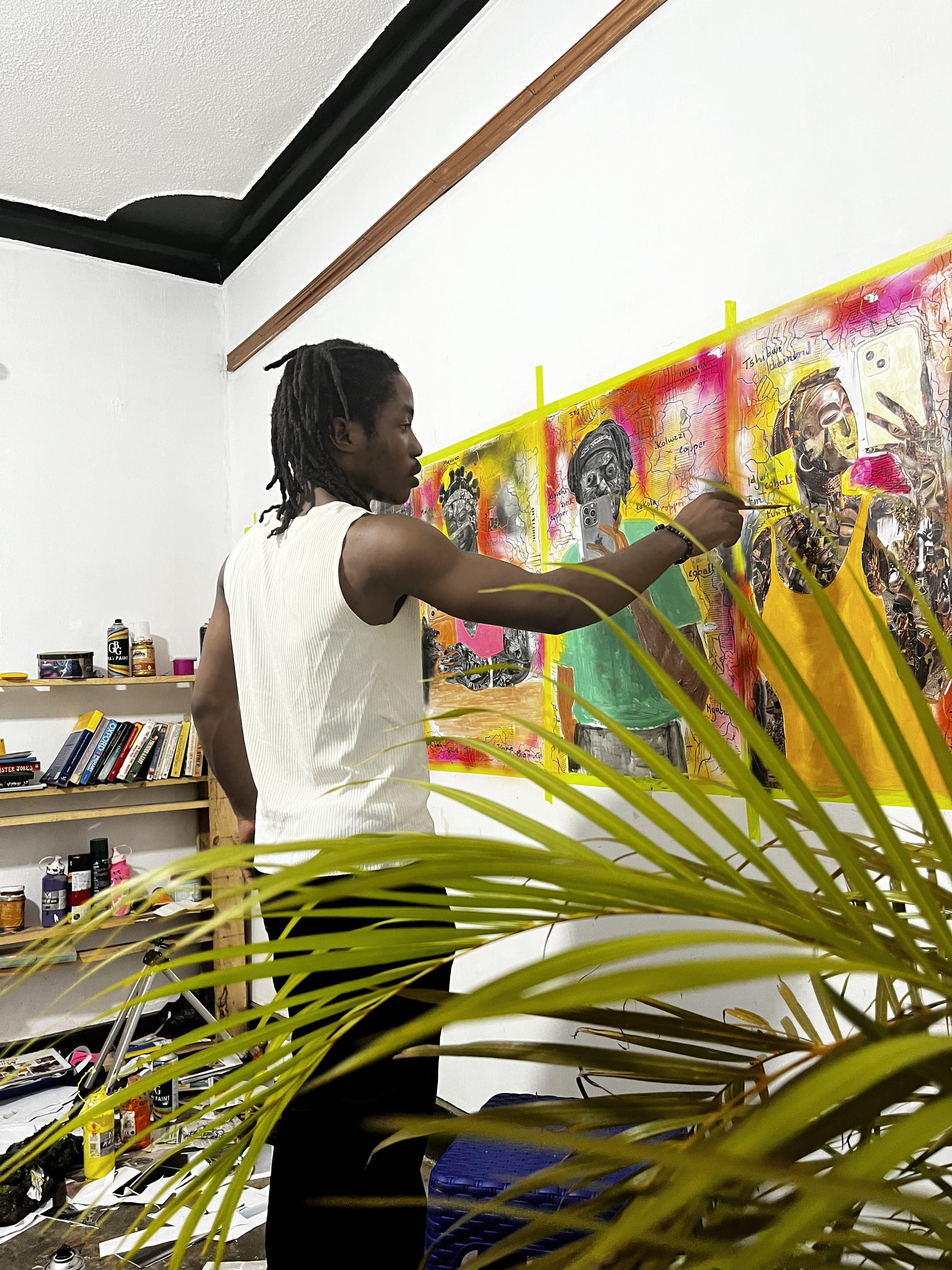
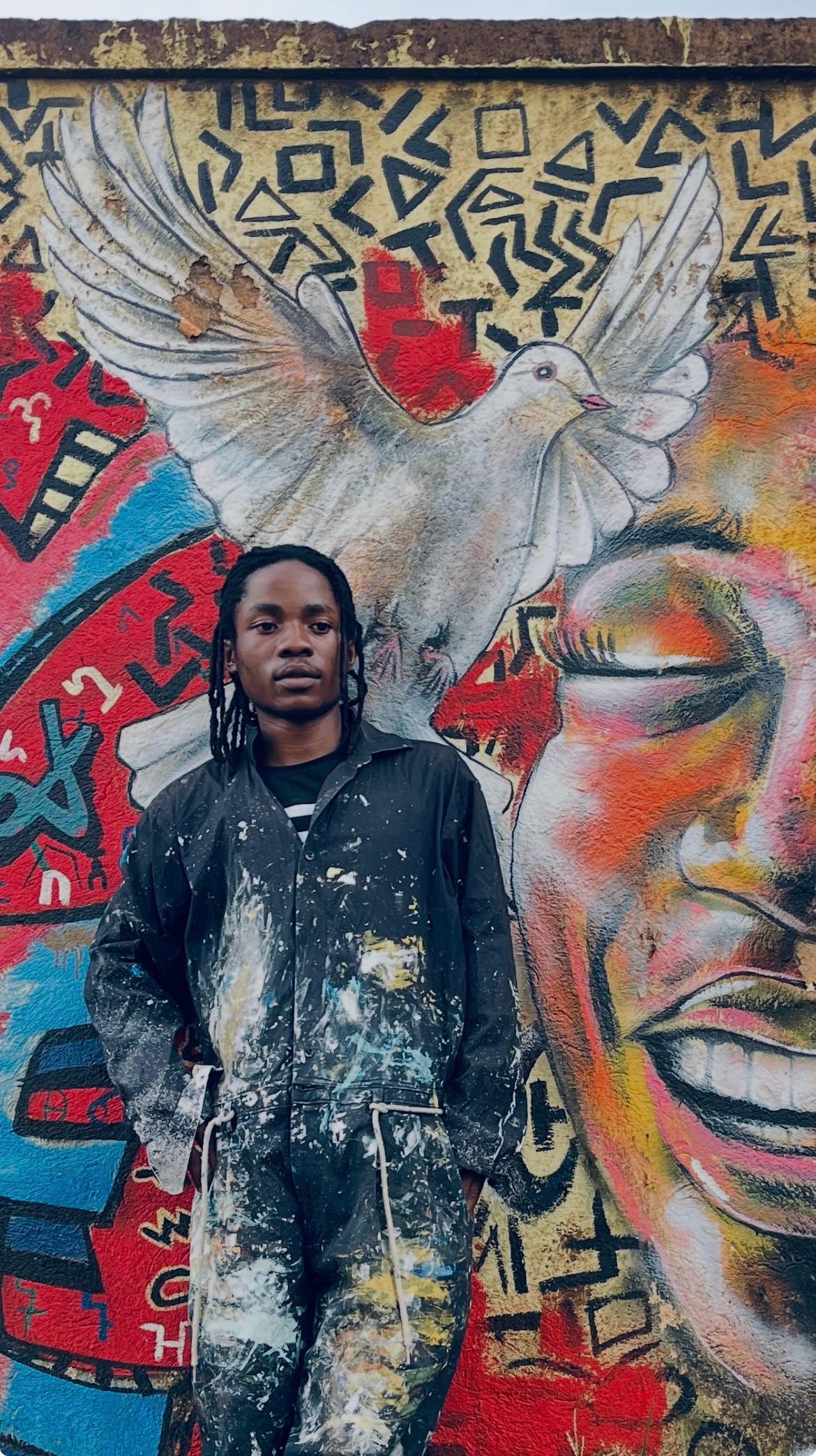
Benjamin Mbula is a visual artist from Bukavu, in eastern Democratic Republic of Congo, now based in Uganda. Working mainly in painting and mixed media, he explores memory, identity, land and transformation, combining fragmented forms, images and materials to show how the past continues to exist within the present.
Growing up in eastern Congo, he was shaped by the region's rich cultural heritage, its complex history, and the ways stories and memories are carried across generations. His ongoing body of thought, Contempo Ancestors, considers the relationship between what we inherit, what we transform and what we leave for future generations.
Rather than reproducing traditional influences, Mbula draws on their ideas of identity, spirituality, protection, transformation, and the connection between the visible and invisible worlds. By reconstructing fragmented forms into new collective compositions, he explores unity within diversity and the movement of ancestral memory into contemporary life. For him, memory is something living: something that can be carried, transformed and passed on.
We spoke with Benjamin about growing up in a politically unstable Congo, leaving and returning, and what migration taught him about identity. He talks us through the spiritual meaning of the mask, his interest in colonial extraction and cobalt, and a layered process built on photomontage and fragmentation. He also shares why he wants his work to open a conversation rather than give answers, and what he believes African art needs to build a lasting future.
What was your childhood in eastern Congo like, and what from that time still follows you into your art today?
I was born in eastern Congo, a region shaped by a lot of atrocity and conflict. The country has been deeply shaped by political issues. People didn't have the freedom to express themselves, and what we might call democracy wasn't something real or practical. It was only statements. Leadership was a bit of a dictatorship for the people living in the country.
It affected me a lot. When you are young, you can't understand it deeply, but as you grow, you start to ask why this regime works this way, and why all these stories affect you. So my childhood was much more political, and that drove me to who I am today, because we create out of our memories. Memory shapes who we are.
Congo was, and still is, a vibrant country, but the political system is what holds it down. There is also a rich, diverse culture, but people don't look at that angle. What they look at is the minerals and resources we have. As a country rich in natural resources, there is a lot of demand from Western countries and from some African countries, and the population becomes the victim. As young as we were, it affected us too.
You mentioned leaving and coming back. Where did you go, why, and how did it affect your art?
The time I moved from Congo to Uganda was in 2022, after the COVID period. I spent about a year in Uganda before returning to Congo. In 2025, I moved to Uganda again, where I have remained since.
Experiencing these movements between two countries changed the way I understand migration. Before, I had heard people talk about migration, but I didn’t fully understand what it meant until I experienced it myself. Moving to a different place exposes you to another reality, different ways of living and different perspectives on the world. Returning home also makes you look at your own environment differently.
This experience gradually pushed me to question how much the places we are born and raised in shape who we become. I started asking myself: Who would I be if I had been born somewhere else? If I had been born in Senegal or Mozambique, for example, would I have the same experiences, history or way of seeing the world?
These questions opened up new directions in my artistic practice. I became interested in how movement between places, encounters with different environments and lived experiences influence the way we understand ourselves and the world around us. Migration became more than simply moving from one country to another; it became a way for me to explore identity, belonging and the process of becoming.
You have an ongoing body of work called Contempo Ancestors, and African masks are a big influence. What do they represent to you?
My practice between 2022 and 2024 was quite different from what I do today. There was a significant transition, as my earlier work focused more on emotional documentation. Now, I'm interested in understanding our history and the value of the stories that connect us. I'm also on a spiritual journey, and that's what the masks in my work speak to. For me, everything is about expression because I believe art is the highest form of human expression.
Growing up in a Christian household, I saw these masks as something associated with witchcraft. But as I began to understand myself on a deeper level, I discovered a connection to them. The Congo has immense cultural diversity, but our education system didn't give us much opportunity to learn about or understand these masks. So I started examining them myself, and what I discovered was that our ancestors had an extraordinary level of consciousness and a deep understanding of their value.
To me, the form of a mask brings together different elements of nature. You find human forms, animal forms and references to trees, all of which speak to the richness of our ecosystem. In this sense, the mask represents the entire ecosystem of our universe. Our ancestors understood that we are interconnected with everything around us. And when I speak about our ancestors, I include myself in that lineage because what I create today will eventually become someone else's inheritance, someone else's story.
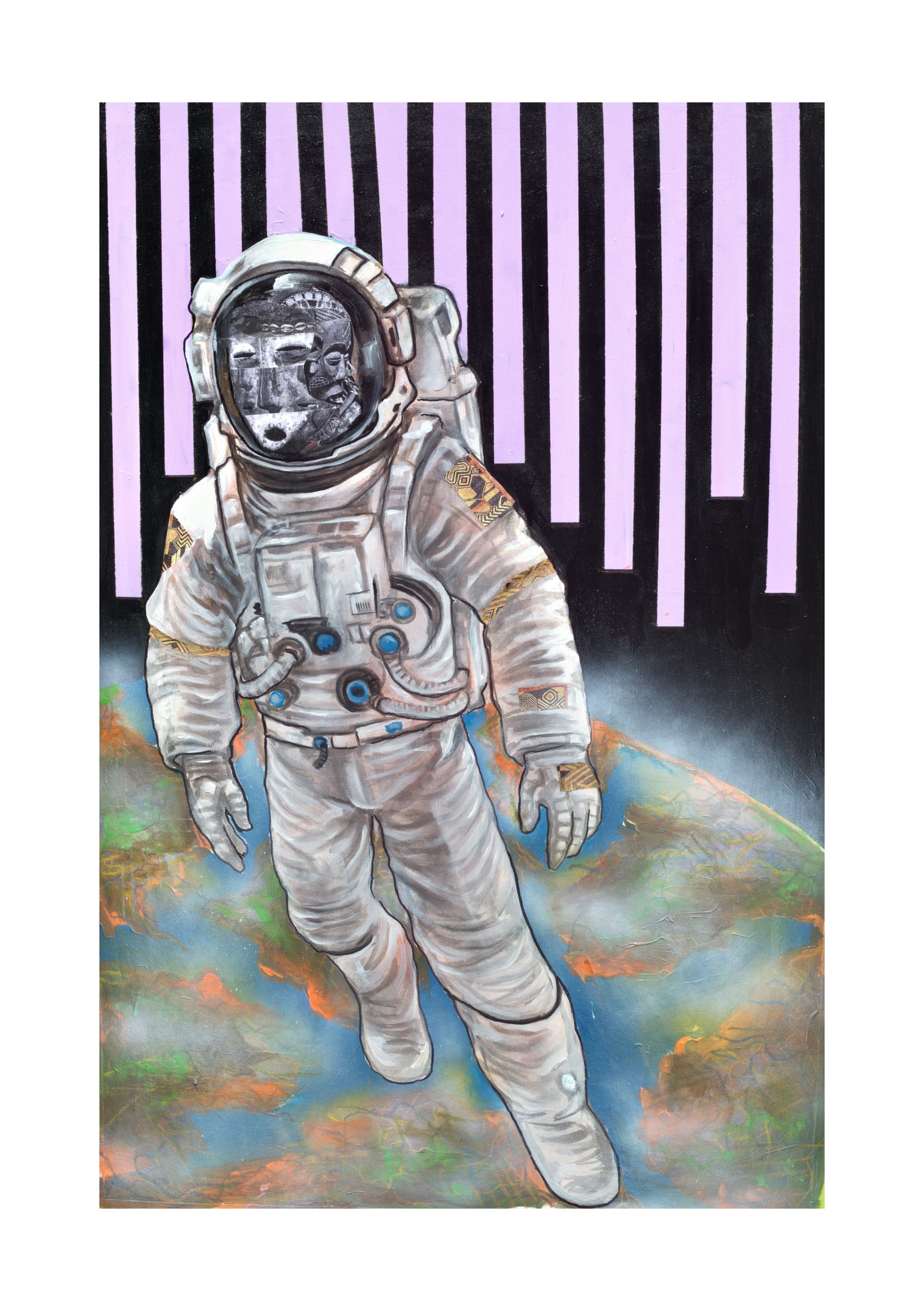
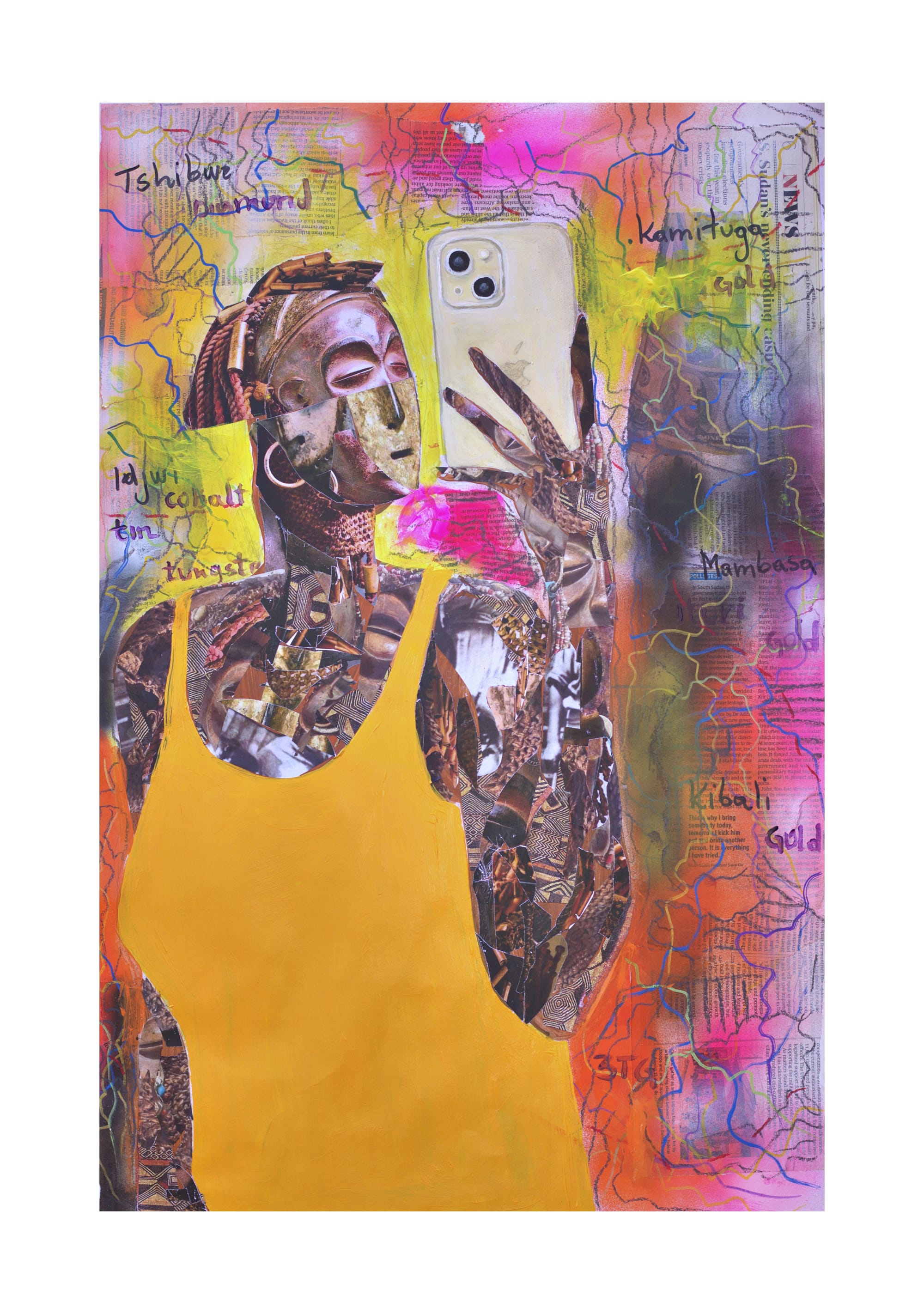
For me, as Benjamin, the mask represents both the visible and invisible worlds: the world we inhabit today and the world of our origins, our ancestors. At its deepest level, it speaks to the relationship between the spiritual and physical worlds. Through my work, I want to bring the significance of the mask into conversation with contemporary forms, exploring what emerges when we combine the knowledge and traditions of those who came before us with the perspectives of those of us living today. To me, the mask is a physical expression of human consciousness.
Are there other patterns, colours or objects that come up often in your work?
Being born in Congo, I grew up surrounded by an incredible diversity of cultures and traditions. I was particularly influenced by Kuba patterns, which carry a philosophy embedded in their stripes and reflect the strength and creativity of women, as they are traditionally created by women. I was drawn to them as a way of exploring women's creativity, their ability to challenge social and political norms, and the spiritual values behind their work. Although these patterns are less present in my practice today, they were an important influence.
I'm also interested in stories of colonialism. Colonial rule was built on extraction, and that economic model continues to shape our social lives in Congo, Uganda and across Africa. Congo, for instance, is one of the world's largest producers of cobalt and industrial diamonds. But who really benefits from this wealth? Our raw materials are extracted, processed elsewhere and returned to us as finished products at much higher prices, while the process leaves behind human rights violations, forced labour and communities that see little benefit.
I'm now exploring these issues through an installation I'm developing, using electronic materials and wires connected to the cobalt industry to create sculptures that speak to extraction and its consequences. These materials may not belong to the traditional cultures we recognise today, but they are part of our contemporary culture and could become traditional in the future. Stories and names evolve with time.
Can you take us through your process, from an idea to the finished work?
I prefer improvising to planning because planning can sometimes make me feel less authentic. Some projects require structure, but with others, I simply begin and learn along the way. I'm also a perfectionist, so I appreciate knowing when to stop, even though my process is all about layering and there is always something more I could add.
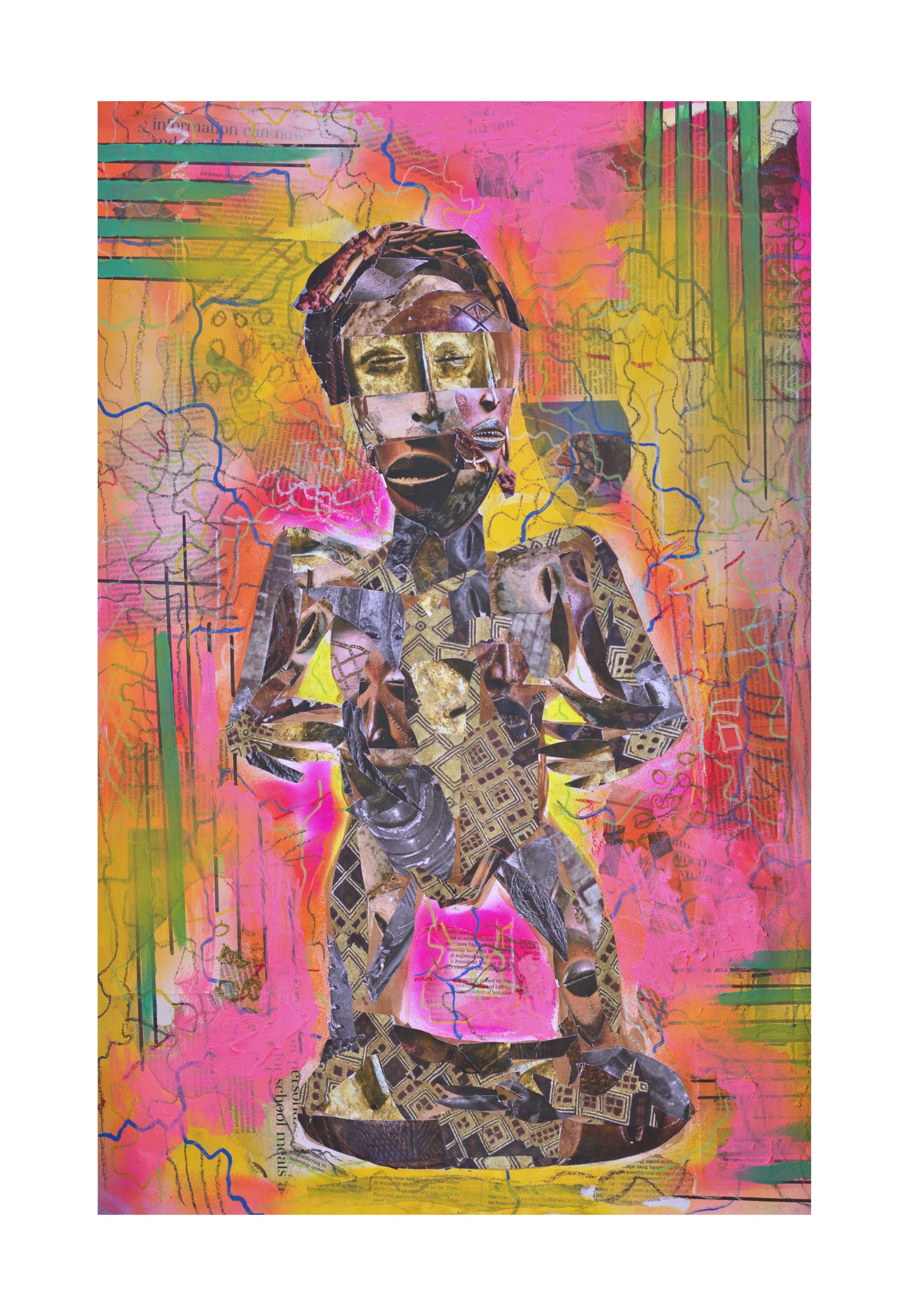
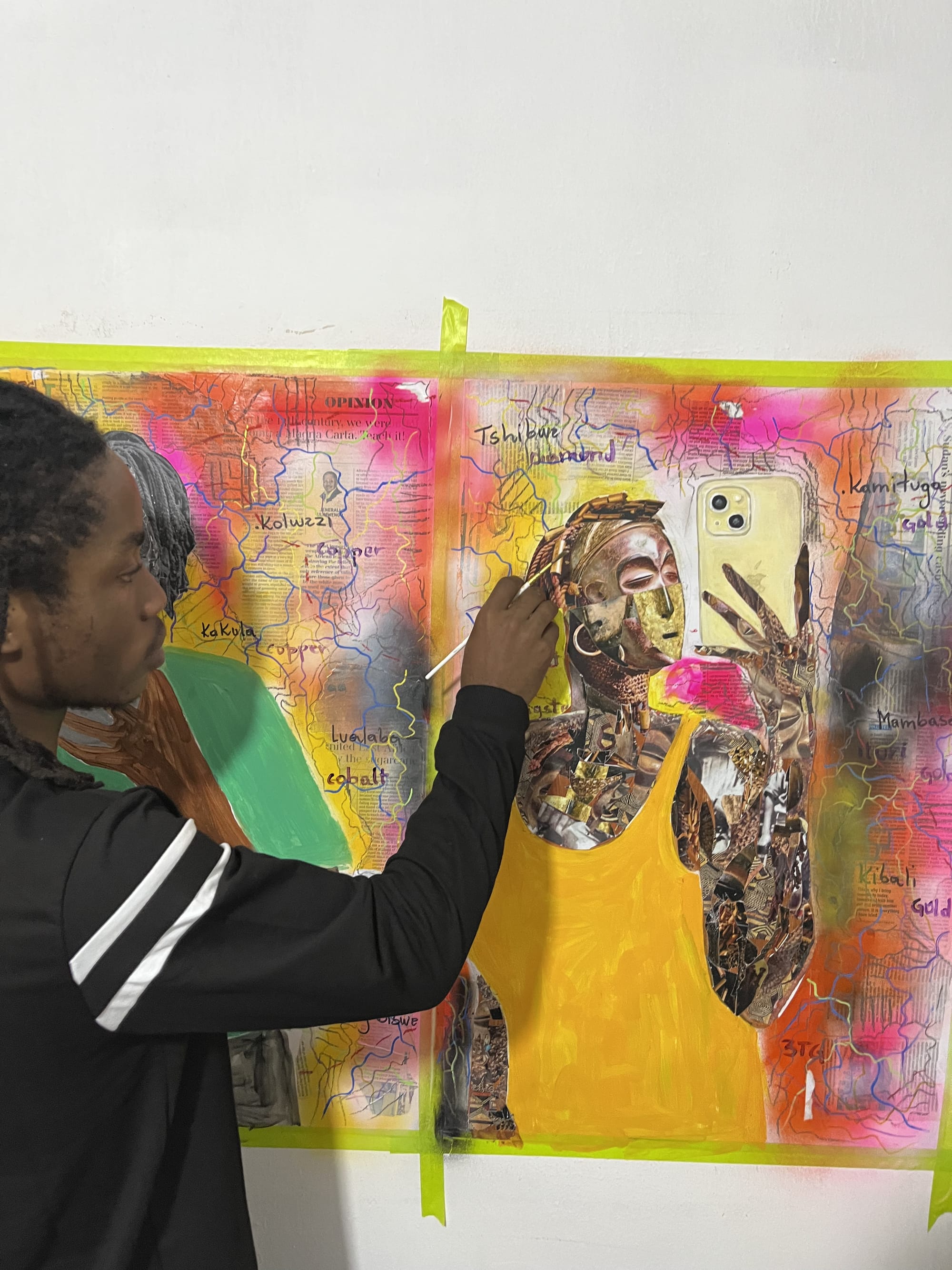
At the moment, I combine painting and photomontage. I collect photographs connected to people I know, personal memories or aspects of my identity. I cut them up and layer them with paintings, often experimenting without knowing what the final composition will look like. I'm exploring identity as something fluid, made up of multiple, constantly evolving layers.
Fragmentation is also central to my work. I see our history, from the pre-colonial to the post-colonial era, as a continuous but fragmented story. I deconstruct and reconstruct images to explore how memories, places and experiences change, disappear and return in different forms. When I bring different masks, histories and childhood memories together, they create new representations, much like our experiences shape who we become. Ultimately, my process is about discovery, and it continues to evolve.
What do you hope someone feels or takes away when they see your work?
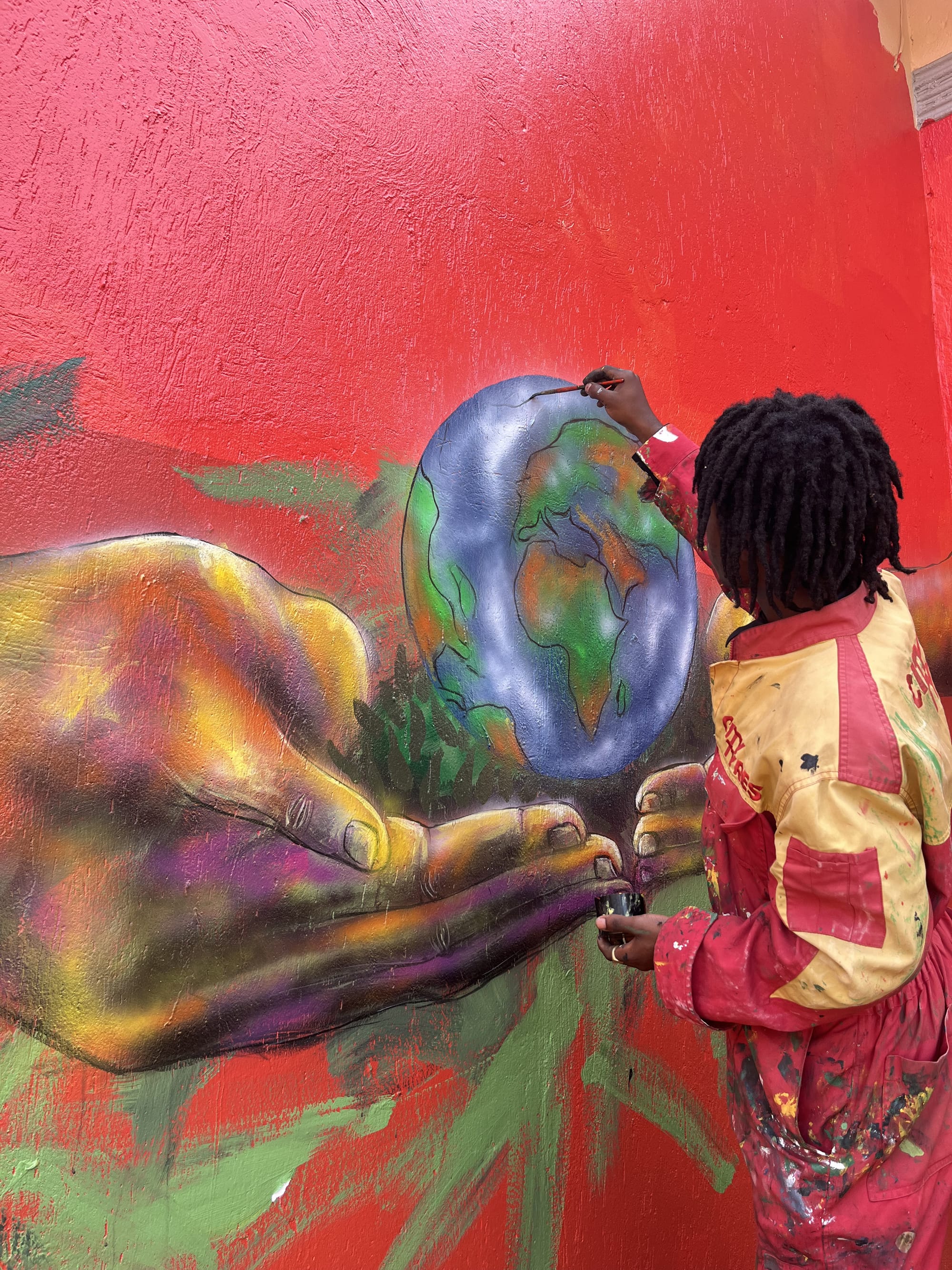
In the past, I felt I needed to provide answers through my work, as though I were the one who knew. But everyone has their own truth. I now see my work as an open conversation. I share how I understand the world, but I also leave room for others to bring their own realities and interpretations.
I don't want people to think the artist is the only one who holds the truth. The work becomes an intermediary between us, creating space to ask questions and explore different histories, stories and memories.
There can be a lot of confusion in my work, particularly because of its fragmentation, and I'm comfortable with that. Life isn't always structured or clear. Sometimes confusion encourages us to ask questions and consider different perspectives.
How important are your community and the people around you to your work?
People play a significant role in my practice. I am here because other human beings are here, and their presence makes certain conversations possible. Without people, I couldn't explore subjects like extraction, capitalism or communism. Life itself is also one of my greatest influences.
However, my practice is gradually expanding beyond people. I've come to understand that all living beings matter, not just humans. I'm interested in exploring the wider ecosystem and recognising that humans aren't its only beneficiaries.
Looking ahead, what do you hope African art becomes better at, and what are you excited about personally?
The future is abstract, but it is shaped by the present and the past. For the African art scene, I hope we begin to understand art not just as culture, but also as education and an economy. Look at the Nigerian music industry: people increasingly recognise music as an industry that creates economic opportunities, not just something we consume. Visual artists need to understand their craft as labour, including the importance of copyright and protecting their intellectual property, which remains a major challenge for creatives across the continent.
We also need infrastructure and platforms for artists, alongside private investment in the wider arts ecosystem. The growth of American art, for instance, was supported by significant investment after the Second World War. Money shapes how art is valued and perceived, so we need to invest in our own industries.
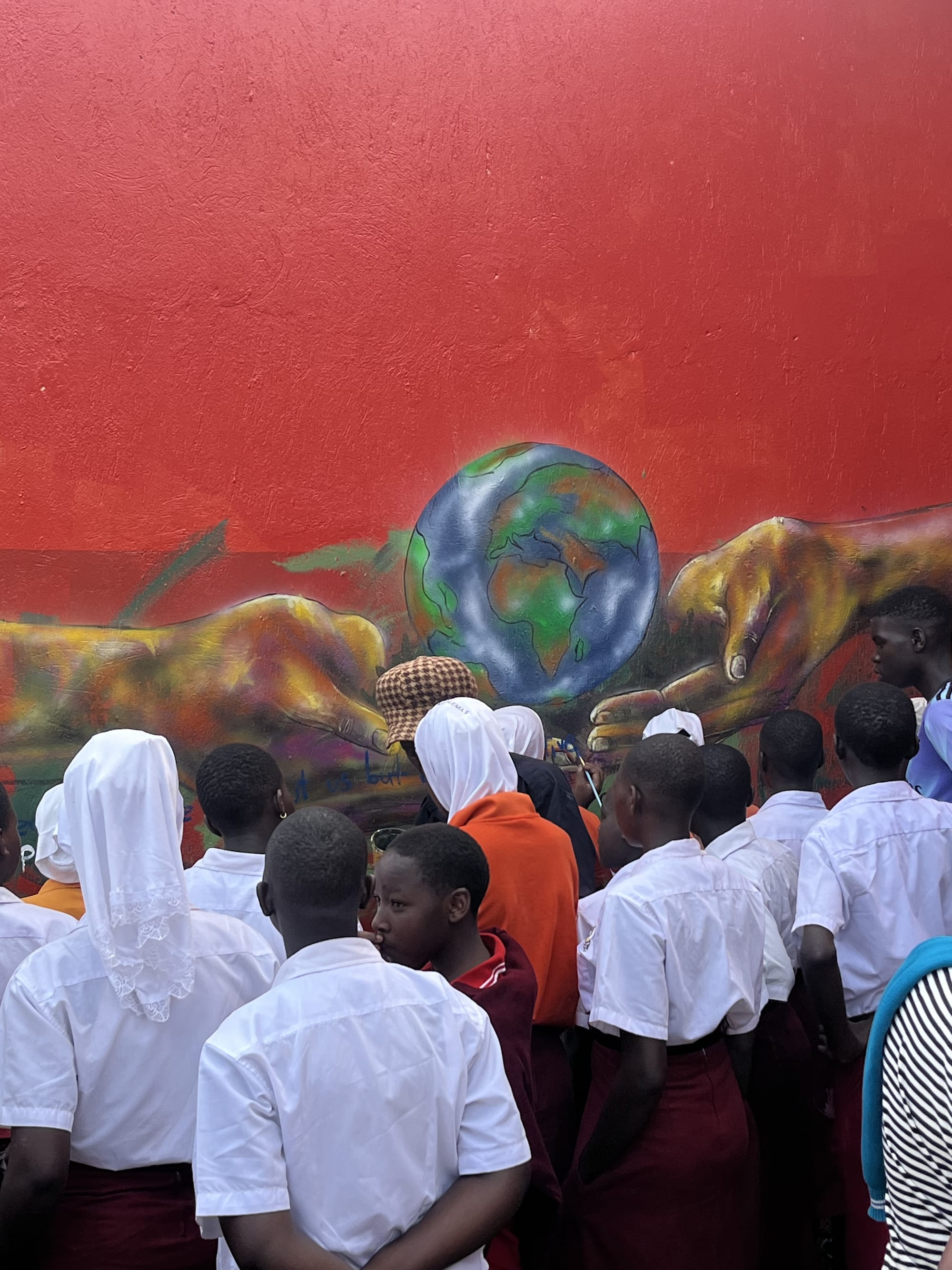
I believe culture inspires art, and art shapes culture. They are interconnected. When everything else disappears, art and culture are what remain, preserving our histories and helping us understand who we are. This is why we must also teach younger generations to engage with art.
Personally, I'm excited about what lies ahead. When I look at how much my practice has evolved since I started taking it seriously in 2022, I can see how far I've come. I believe this work will grow into something meaningful, but with greater knowledge comes greater responsibility. As I progress, I want to contribute to building our art ecosystem. We may not be able to build everything, but we can each play a part in creating a scene where our work is supported, valued and actively consumed.



Member discussion